
CONNECTING QUANTUM RESEARCH. ACROSS EVERY DISTANCE.
A quantum internet.
From Earth
to orbit.
Model the links. Understand the limits.
Design the next generation of terrestrial
and space quantum networks.
A research project at the University of Luxembourg
Funded by the European Space Agency
One connected framework.
A SHARED HORIZON


01 / THE PROJECT
FROM PHYSICAL LINKS TO NETWORK BEHAVIOURTomorrow’s networks.
Today’s research questions.
The quantum internet needs more than a good link. It needs a network that works together.
QNETSIM brings optical channels, satellites, quantum memories and network control into a modular simulation environment. It helps researchers examine how physical constraints shape entanglement distribution across Earth and space.
Visit the institutional project page ↗INSIDE QNETSIM
One stack.
From photons to applications.
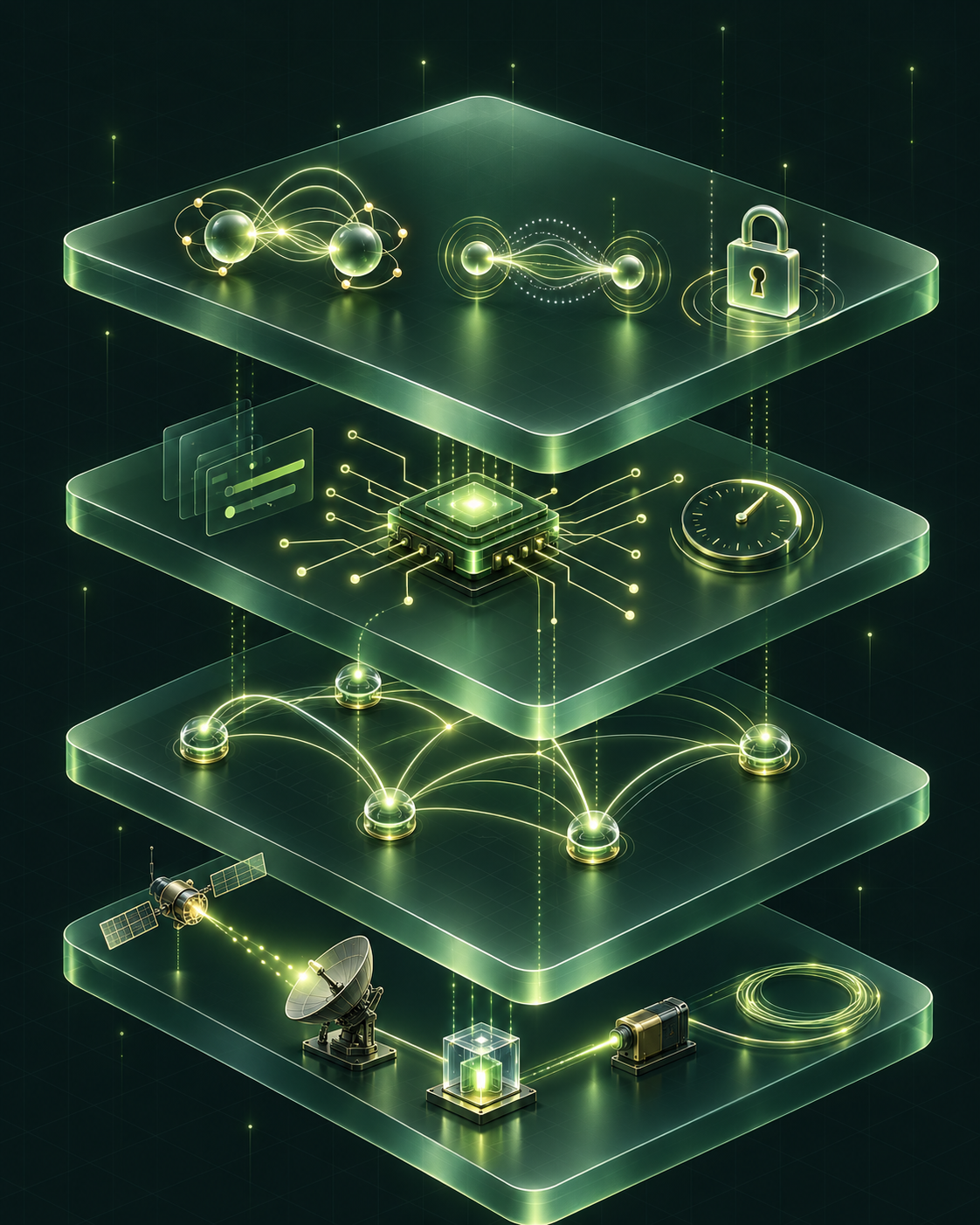
Four connected layers bring physical models, quantum-network protocols and operational control into one simulation framework.
- TURN NETWORKS INTO SERVICES
Application layer
Explore entanglement distribution, teleportation and quantum-network use cases.
- COORDINATE THE RESOURCES
Control & management
Connect memory scheduling and resource allocation with network orchestration.
- CONNECT QUANTUM NODES
Network layer
Build topologies, select routes and distribute entanglement through swapping.
- MODEL THE PHYSICAL WORLD
Physical layer
Describe photon sources, fibre and free-space channels, quantum memories and detectors.
02 / USE CASES
ONE FRAMEWORK. DIFFERENT HORIZONS.Explore the architectures.
From a terrestrial repeater to a moving constellation,
study the constraints that matter.
03 / INTERACTIVE DEMONSTRATION
QNETSIM PARAMETER EXPLORERChange the perspective.
See what changes.
Explore recorded satellite-pass results.
Choose a parameter. Compare the outcomes.
Model & assumptions +
Source fidelity 0.99; 606 nm carrier; 1 m receiver; 10° minimum elevation; 1,000 s memory retrieval lifetime.
Baseline: 256 slots per node, T₂ = 30 s, and 0.5 µrad pointing jitter per axis. The scheduling comparison uses T₂ = 3 s. Each sweep varies one specified input.
Ready to define your own scenario? Run the full simulator ↗
04 / RESEARCH & RESOURCES
Explore the repository ↗Built to be explored.
Documented to be understood.
Follow the models, inspect the assumptions,
and take the research further.
SATELLITE + HYBRID NETWORKS
Memory-assisted design
of quantum networks
Project manuscript · Author-provided versionFrom physical constraints
to network performance.
QNETSIM for memory assisted design of satellite and hybrid quantum networks introduces the modular framework and its space–ground scenarios, linking physical models and operational policies to fidelity, throughput, latency and memory use.
S. Koudia, F. Vista, H. Peng, I. Maity, I. Bedhief, J. C. Hernandez Hernandez and S. Chatzinotas. Author-provided manuscript; publication status is not asserted.
Read the manuscript ↗Code & project information
05 / PEOPLE & COLLABORATION
UNIVERSITY OF LUXEMBOURG · SNT · SIGCOMA shared vision.
A connected team.
Bringing quantum communications, space systems
and network research into the same conversation.
THE NEXT CONNECTION STARTS HERE
Let’s explore what
comes next.
Have a research question, a network architecture,
or a mission concept in mind?